
BY IBRAHEEM A WAZIRI, FEBRUARY 21, 2026 | 02:59 PM
There are books you read to collect facts, and there are books you read to collect yourself. But there is a rarer kind—books you read to locate your civilisation, to ask where you stand in the long, complicated memory of history. Muhammad Mojlum Khan’s The Muslim 100: The Lives, Thoughts and Achievements of the Most Influential Muslims in History (Kube Publishing, 2008) belongs to that third category.
On the surface, it is a catalogue of Muslim greatness: a hundred lives arranged in ranked order, a roll-call of the Ummah’s most decisive personalities. Yet beneath that structure lies something more revealing. The book is a map. And every map, however sincere, carries the cartographer’s assumptions: what counts as influence, where Islam’s gravitational centres are believed to have been, and which kinds of achievement deserve to be remembered.
For a reader from Northern Nigeria—from the Sahel, where Islam arrived not as a single event but as a climate, not as a flash but as a slow settling of law, language, scholarship, trade ethics, prayer, and public morality—this book produces a particular kind of admiration mixed with a particular kind of ache.
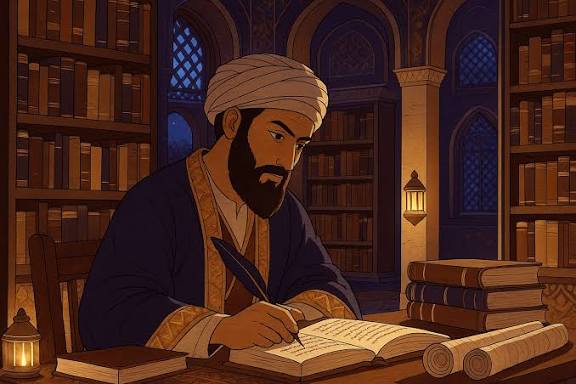
I did not begin The Muslim 100 from the top of the list, where the Prophet Muhammad ﷺ stands as the axis of meaning and history. I began where curiosity became almost personal: Nizam al-Mulk.
Years ago, while reading Jonathan Brown’s The Canonization of al-Bukhari and Muslim (2007), I encountered the striking assertion that it was Nizam who initiated the process that helped make the two Sunni hadith collections into something like formal canons. Since then, Nizam al-Mulk has remained one of those figures who quietly refuse to leave your mind.
In Khan’s ranking, Nizam al-Mulk sits at #27—above many conquerors, above many poets, above many scientists, and above several modern founders of states. At first glance, it feels surprising. Because he was not a prophet, not a caliph, not a hadith compiler, not a philosopher whose name travels effortlessly through university syllabi. He was, in the simplest sense, a vizier: a man of offices and ink, of appointments and endowments, of policy, discipline, and institutional design.
He lived in the 11th century, in that uneasy moment when the Abbasid caliphate still existed as a symbolic centre but had been politically weakened, while real power shifted into the hands of Turkic dynasties. The Seljuks—Sunni, militarily formidable, politically ambitious—presented themselves as protectors of the Abbasid order even as they governed in practice. It was within this volatile arrangement that Nizam rose: a Persian administrator who became vizier to Sultan Alp Arslan and later to Sultan Malik Shah.
His life was not one of battlefield glory. It was one of statecraft: balancing tribal military elites, securing legitimacy through religion, and building institutions sturdy enough to outlive the mood swings of courts. He was assassinated in 1092—traditionally linked to the Nizari Ismailis, those “Assassins” of medieval legend. But by then, the pattern had already been laid down.
Nizam al-Mulk’s genius was not that he served a state. It was that he understood a civilisational secret: knowledge survives only when it is institutionalised. Civilisations do not endure on heroism alone. They endure because someone builds systems strong enough to outlive heroes. Nizam al-Mulk was that someone.
Through the famous Nizamiyya madrasas, he did not merely fund education. He standardised the very idea of education at scale. He helped transform Islamic learning from scattered circles into an institutional pipeline—producing scholars, judges, administrators, and teachers as a reproducible class. And once knowledge becomes reproducible, it becomes civilisational.This is why his placement in Khan’s list feels intellectually satisfying. It signals that influence is not always loud. Sometimes it is administrative. Sometimes it is the ability to make learning durable.
A Sahelian reader understands this instinctively. Because what is Sahelian Islam—the Islam of Kano, Katsina, Zaria, Sokoto, Borno, Timbuktu, and Jenne—if not a far-flung echo of the same institutional logic? The study circles, the prestige of the scholar, the centrality of foundational texts, the marriage of governance and learning, the belief that Islam must be taught systematically to endure—these are not accidents. Even where we did not copy Nizamiyya schools directly, we absorbed the logic they helped formalise: that knowledge becomes durable when it is given an institution.
This is why Nizam’s shadow reaches us even if his name is not spoken in the marketplace. In Sokoto, for instance, the Caliphate’s greatest weapon was not the sword. It was the pen. It was the conviction that scholarship is authority, that governance must kneel before moral law, and that reform must be intellectual before it becomes political. That is Nizam’s world translated into Sahelian language—a reminder that the Sahel’s Islam has always been more institutional than imperial.
In a sense, The Muslim 100 is Islam’s answer to Michael Hart’s famous and controversial The 100: A Ranking of the Most Influential Persons in History. Like Hart, Khan attempts what most writers fear: to rank influence across centuries, cultures, and domains, knowing full well that ranking is a dangerous literary form. The moment you number human beings, you invite quarrel. The moment you rank religious figures, you invite outrage.
Yet Khan’s courage is not trivial. Muslim readers often celebrate the past through reverence, not through analytical comparison. Khan breaks that pattern. He dares to ask: who shaped Islam most—not merely who was righteous, but who was influential across centuries, continents, institutions, and imaginations.
But unlike Hart—whose list can feel cold and reductionist—Khan writes as a Muslim conscious of tradition, reverence, and intellectual lineage. The Prophet ﷺ is not merely “influential”; he is the centre of meaning. The Companions are not just political figures; they are moral archetypes. The hadith compilers are not mere editors; they are guardians of sacred memory.
In that sense, the book is pioneering not only in scope but in tone: it attempts scholarship without cynicism, and admiration without naïveté. Its criteria are impressively wide. He refuses to reduce influence to scholarship alone, or politics alone. His list contains founders and Companions, jurists and hadith compilers, theologians and philosophers, scientists and physicians, poets and cultural giants, Sufi saints and spiritual network-builders, sultans and empire-shapers, modern ideologues and reformers, and global symbols of Muslim identity like Malcolm X and Muhammad Ali.This range is not a weakness. It is a recognition of a deep truth: Islam did not survive by one type of genius. It survived because it produced many kinds.
Firdausi, was ranked #74. Many Muslims outside Persianate cultures do not immediately think of Firdausi when asked about Islamic influence. Yet his Shahnameh( Book of Kings) preserved Persian memory inside an Islamic civilisation and gave Muslim courts and poets a language of heroism, tragedy, and moral struggle. Firdausi proved something that matters far beyond Persia: Islam did not erase civilisations; it absorbed them and gave them a new ethical horizon.
The Sahel understands this instinctively. Here, Islam did not erase Hausa, Kanuri, Fulani, Songhai, or Tuareg cultures. It disciplined them, educated them, and made them part of a larger moral universe. Firdausi belongs on the list because civilisations are shaped not only by law and creed, but by the stories they tell themselves. Influence travels in unexpected forms.
Every Hausa child who grew up reading Iliya Dan Mai Karfi knows—without knowing Firdausi’s name—the tragic duel of father and son, echoing Rustam and Sohrab from the Shahnameh. Can we prove a direct line? No. But civilisations do not always move by direct citation. They move by diffusion. Stories migrate. Themes cross deserts. And in the Sahel, such cross-pollination is not a surprise; it is almost the definition of the region.
Khan’s modern entries are equally provocative. Atatürk forced Muslims to confront modernity. Ibn Saud reshaped religious authority through oil. Muhammad Yunus changed the economic imagination of poverty. Muhammad Ali made Muslim identity confident in the global arena. Khan writes an influence list, not a piety list—and influence, as history keeps teaching us, is morally complicated.
Yet this is also where the Sahelian reader pauses.The book narrates Islam primarily through Arabia, Iraq, Persia, the Levant, Andalus, Ottoman Turkey, and South Asia. Sub-Saharan Africa appears as an afterthought, with only Uthman Dan Fodio at #96. This is not merely an omission. It is a distortion.
West Africa deserves more: Mansa Musa, Askia Muhammad, Ahmad Baba, Mai Idris Alooma, Shaykh al-Kanemi, Nana Asma’u, Ahmadou Bamba, Ibrahim Niasse. Their influence was not local trivia. It was civilisational.What we see here is the tyranny of written visibility.
The Sahel’s manuscripts were rich but ignored. Timbuktu’s libraries were vast but under-taught. Sokoto’s intellectual tradition remains strangely invisible in global Muslim historiography. Khan’s list, in this sense, reflects not only his judgement, but the bias of global scholarship itself.
And yet, the book still performs a valuable task. It restores scale. It reminds the reader that Islam’s survival was not inevitable; it was engineered—through conquest, yes, but also through scholarship, institutions, poetry, commerce, and spiritual networks. It quietly forces the question: what is influence?
Nizam teaches us that influence can be administrative. Firdausi teaches us that influence can be literary. The Sahel teaches us that influence can be rooted, patient, and unacknowledged.
In the end, The Muslim 100 is a map that forgets certain rivers. It is useful, impressive, and often intellectually nourishing. But those of us who live near the waters feel the urge to redraw it.
May Allah reward Khan for his ambition. And may Allah raise among us writers for the Sahel’s manuscripts, courts, circles, pens, and unnamed teachers—whose influence entered souls without ever entering global footnotes—so that we may be heard loudly and in multitude in the next version of the world’s hundred.

Conflict Reporting is dangerous and risky. Our reporters constantly face life-threatening challenges, sometimes surviving ambushes, kidnap attempts and attacks by the whiskers as they travel and go into communities to get authentic and firsthand information. But we dare it every day, nonetheless, in order to keep you informed of the true situation of the victims, the trends in the conflicts and ultimately help in peace building processes. But these come at huge cost to us. We are therefore appealing to you to help our cause by donating to us through any of the following means. You can also donate working tools, which are even more primary to our work. We thank you sincerely as you help our cause.
Alternatively, you can also email us on
info@yen.ng or message us
via +234 803 931 7767
